
Female Health · Science Hero Editorial
Bee Pollen and Fertility: What Scientists Have Actually Found
Can bee pollen improve fertility? Explore ovarian-cell studies, animal research, PCOS evidence and what is still missing in human fertility trials.
The fertility story around bee pollen sounds almost designed for social media.
Women describe taking it while trying to conceive. Wellness advocates connect its nutrient profile with reproductive health. And because pollen itself carries the biological machinery of plant reproduction, the association feels intuitively appealing.
But intuition is not evidence.
What makes this story scientifically interesting is that bee pollen has actually been investigated in ovarian cells, female rats and an experimental model related to polycystic ovary syndrome.
That does not mean bee pollen has been shown to help women become pregnant.
It means the question has a genuine research trail.
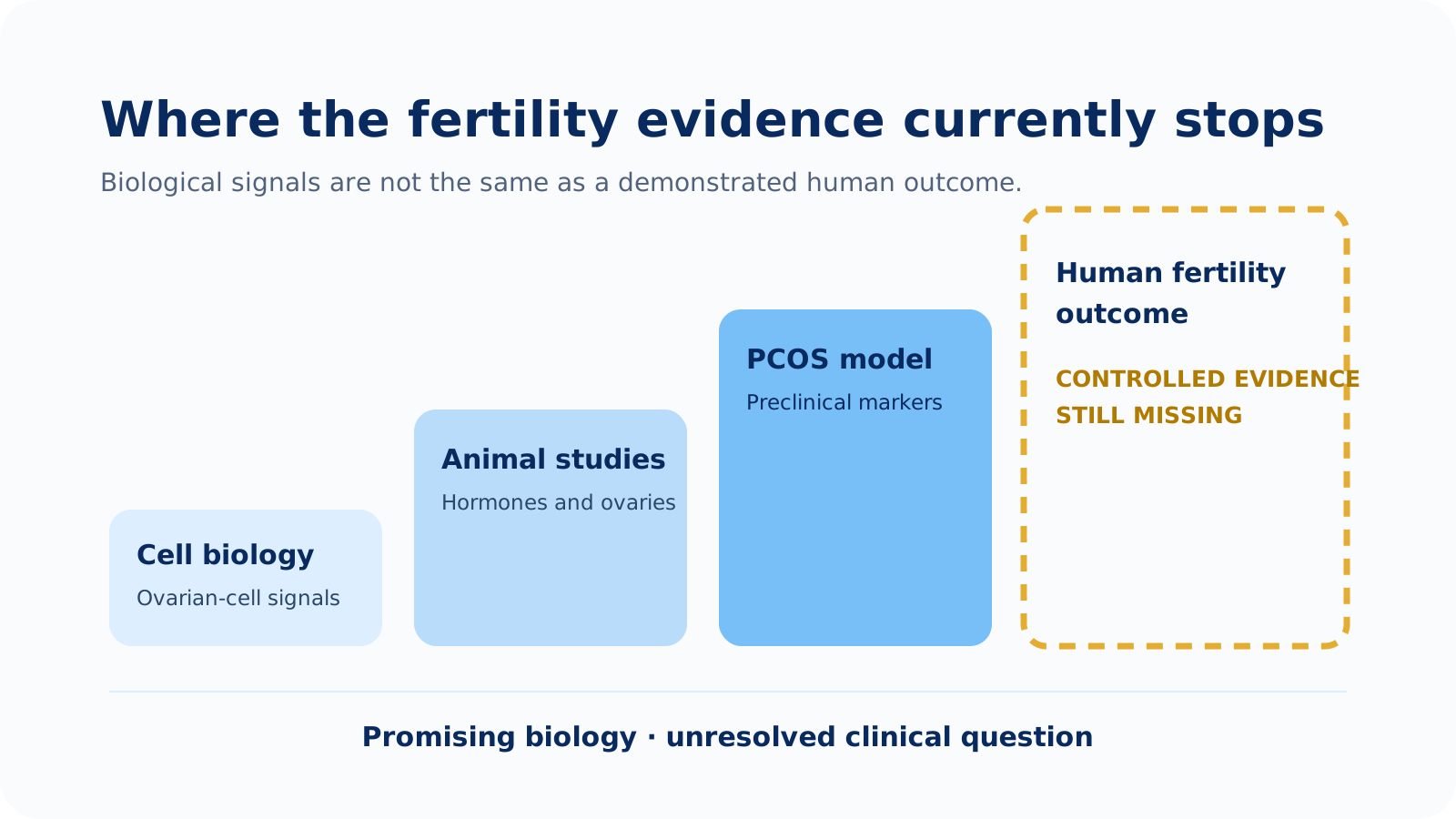
Understanding that trail requires separating three very different things:
biological activity, reproductive mechanisms and actual fertility outcomes.
Researchers first found that bee pollen can affect ovarian biology
One of the foundational studies was published in 2013.
Kolesarova and colleagues fed female rats diets containing either no pollen, 0.3% rapeseed bee pollen or 0.5% bee pollen for 90 days.
Afterward, ovarian tissue was examined.
The study reported changes in:
- progesterone secretion,
- estradiol secretion,
- IGF-I release,
- and apoptosis-related markers.
This matters because progesterone and estradiol are central components of reproductive physiology.
But the result is often easier to overinterpret than it appears.
The study did not measure:
- human ovulation,
- time to pregnancy,
- implantation,
- miscarriage,
- or live birth.
It demonstrated that dietary bee-pollen exposure was associated with measurable ovarian changes in a rat model.
That is preclinical evidence, not a fertility treatment result.
Then researchers discovered that different pollens produced different effects
A 2020 experiment makes the story more complicated.
Sirotkin and colleagues exposed porcine ovarian granulosa cells to bee pollens originating from five plant species:
- alder,
- dandelion,
- maize,
- rapeseed,
- willow.
Their study in Pharmaceutical Biology found that the pollens did not behave identically.
The researchers observed changes in:
- cell viability,
- proliferation,
- apoptosis,
- and IGF-I release.
Importantly, some of those changes were not straightforwardly “beneficial.”
All tested samples reduced cell viability while increasing several measures related to proliferation and apoptosis.
This finding exposes a major weakness in the phrase:
“Bee pollen is good for fertility.”
Which bee pollen?
At what concentration?
From which plant?
In which biological context?
A substance can be biologically active without being clinically beneficial.
That distinction is essential.
PCOS created another line of investigation
The most directly fertility-related preclinical study in the Science Hero review examined an experimental model of polycystic ovary syndrome.
PCOS is a complex endocrine and reproductive condition associated with ovulatory dysfunction in many women.
Naseri, Khazaei and Khazaei studied bee pollen in an estradiol-valerate-induced rat PCOS model.
Fifty-four Wistar rats were distributed across control, disease-model, metformin, bee-pollen-dose and combination groups.
Bee pollen was tested at different doses.
The 2022 study reported changes involving:
- preantral and antral follicles,
- cystic follicles,
- TNF-alpha,
- nitric oxide,
- Ki67 expression,
- and granulosa-cell apoptosis.
Those findings provide a plausible experimental reason to keep investigating reproductive biology.
But there is an enormous translational gap.
An experimentally induced PCOS-like condition in rats is not equivalent to the heterogeneous syndrome diagnosed in humans.
And changes in follicular structure or inflammatory markers are not the same as improved pregnancy rates.
The free Science Hero report follows the bee-pollen fertility story from ovarian biology through animal evidence and the human-evidence gap.
The missing experiment is the one that matters most
A study capable of establishing a fertility benefit in women would look very different.
Researchers would need to:
- clearly define the fertility problem,
- standardise the exact pollen preparation,
- specify the dose,
- use an appropriate placebo or comparator,
- control major confounding factors,
- monitor adverse events,
- and measure clinical endpoints.
Those endpoints might include:
- ovulation,
- time to pregnancy,
- clinical pregnancy,
- miscarriage,
- and live birth.
Through the research cut-off date of 22 August 2026, the Science Hero review identified no controlled human trial demonstrating that raw bee pollen increases pregnancy or live-birth rates in women.
That absence matters.
It does not prove that bee pollen has zero reproductive effect.
It demonstrates that the popular claim has moved further than the human evidence.
Why pregnancy testimonials cannot answer the question
Pregnancy is influenced by many variables:
- age,
- ovarian reserve,
- ovulation,
- sperm quality,
- tubal factors,
- embryo quality,
- timing,
- fertility treatments,
- body composition,
- metabolic health,
- and chance.
A woman can begin taking bee pollen and become pregnant later.
Both events can be true without one causing the other.
This is why testimonials are useful for generating hypotheses but weak for establishing causality.
People who experience an apparent positive result are also more likely to tell others about it.
That can create a powerful selection effect online.
Male fertility research complicates the story further
Bee pollen has also been investigated in male reproductive models.
Rabbit studies have reported changes in semen quality, hormones and reproductive performance under particular feeding conditions.
A 2020 rat study examined methotrexate-induced testicular injury and reported changes in testosterone, oxidative stress, sperm abnormalities and tissue findings.
But negative results exist too.
A zebrafish study found that dietary bee pollen did not improve egg production or embryo viability.
That is important because genuine biological effects are often context-dependent.
If bee pollen were a universal fertility enhancer, results would be expected to converge much more consistently across models.
They do not.
Human pollen research exists — just not where many people think
Pollen-derived products have reached human clinical research.
Standardised flower-pollen extracts have been studied in:
- chronic prostatitis/chronic pelvic pain syndrome,
- menopausal symptoms,
- urinary symptoms,
- and current reproductive research programmes.
ClinicalTrials.gov also lists a registered programme involving a Graminex-containing nutraceutical for infertility associated with male accessory glands.
But this introduces another crucial distinction:
standardised pollen extract is not the same intervention as raw bee pollen.
Extraction can remove or alter the pollen wall, concentrate specific fractions and create a reproducible dose.
A result from a defined extract cannot automatically be transferred to a spoonful of mixed pollen granules.
What the research actually shows
What We Know
Bee-pollen preparations can alter reproductive-cell and ovarian biology in laboratory and animal systems.
Female-rat studies report hormonal and ovarian changes.
Cell studies show source-specific effects.
A PCOS-related animal model produced changes in follicular, inflammatory and granulosa-cell markers.
What Looks Promising
The repeated observation that pollen-derived preparations can interact with reproductive biology justifies further translational research.
Source-specific effects may eventually help identify which compounds or preparations deserve human testing.
What We Still Don’t Know
We do not know whether ordinary raw bee pollen:
- improves ovulation,
- increases pregnancy rates,
- improves live-birth rates,
- treats PCOS,
- or improves infertility in women.
Pregnancy-specific safety data are also limited across heterogeneous consumer products.
Safety deserves particular attention around conception
A supplement promoted for fertility should be judged more carefully, not less carefully.
Bee pollen can contain plant allergens.
Human cases of severe allergic reactions, including anaphylaxis, have been documented.
Commercial products may also differ in:
- pesticides,
- pyrrolizidine alkaloids,
- trace metals,
- fungi,
- and mycotoxins.
That does not mean every bee-pollen product is unsafe.
It means pregnancy and fertility claims cannot be separated from product identity and quality control.
The fertility story is more interesting than a yes-or-no answer
Bee pollen is not currently an evidence-based fertility treatment.
But the research is not empty.
There are legitimate ovarian, hormonal and reproductive signals in laboratory and animal systems.
That makes the responsible conclusion more nuanced:
There is enough biology to justify further research. There is not enough human evidence to promise pregnancy.
That is exactly why this field remains worth watching.
The Science Hero Premium Report maps the complete fertility evidence — ovarian cells, the 90-day rat study, PCOS models, male reproduction, human extract research, current trials, safety and all original sources.
Research Summary
Can bee pollen improve female fertility?
Controlled human evidence demonstrating improved pregnancy or live-birth rates from raw bee pollen was not identified through 22 August 2026.
Has bee pollen been studied in ovarian biology?
Yes. Laboratory and animal studies report changes in ovarian cells, reproductive hormones and related biological pathways.
Has bee pollen been studied in PCOS?
A rat PCOS model reported changes in follicular, inflammatory and granulosa-cell markers. This remains preclinical evidence.
Are animal fertility studies proof for humans?
No. Animal and cellular findings generate hypotheses but cannot establish human fertility efficacy.
Are pollen extracts being tested in humans?
Yes. Standardised pollen-derived extracts have entered several human research programmes, but these products are not equivalent to raw retail bee pollen.
Original scientific sources
- Kolesarova et al. 2013 — Bee pollen and rat ovarian functions
- Sirotkin et al. 2020 — Pollen-source-specific ovarian cell effects
- Naseri et al. 2022 — Bee pollen and metformin in a rat PCOS model
- Saral et al. 2020 — Bee pollen in methotrexate-induced testicular injury
- Di Chiacchio et al. 2021 — Zebrafish reproductive performance