
Wellness Trends · Science Hero Editorial
Is Bee Pollen Safe? What the Research Says About Allergy and Product Quality
Is bee pollen safe? Explore documented allergy risk, anaphylaxis, pesticides, plant toxins, mycotoxins and why product quality matters.
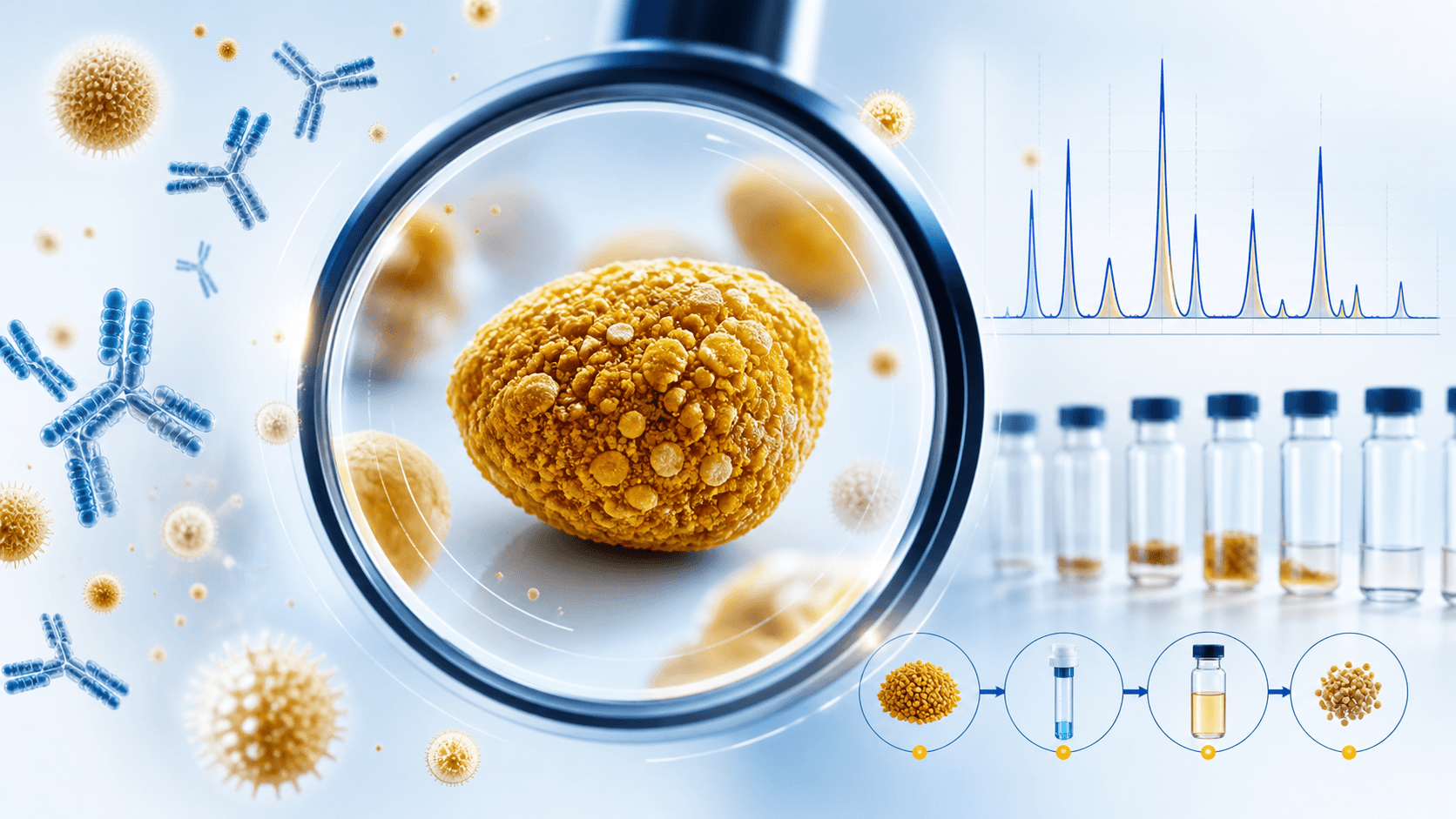
“Natural” is one of the most persuasive words in wellness.
It suggests familiarity, purity and low risk.
Bee pollen fits that image almost perfectly. It is harvested from flowers, carried by bees and commonly sold with minimal visual transformation.
But natural origin does not create a quality-control system.
A serious safety assessment of bee pollen has to consider at least three separate questions:
- Can the pollen itself trigger biological reactions?
- Can it interact with medicines or vulnerable physiological states?
- What else might enter the product from plants, landscape, storage or processing?
The scientific literature contains meaningful evidence in all three areas.
Bee pollen can trigger severe allergic reactions
The clearest human safety signal is allergy.
Systemic reactions after ingesting pollen products have been documented for decades.
Reports appeared as early as 1979 and 1981.
A particularly useful case was published in 2015.
A 40-year-old man with seasonal allergic rhinitis consumed approximately one tablespoon of bee pollen.
Within an hour he developed symptoms including:
- generalised urticaria,
- facial swelling,
- difficulty breathing,
- abdominal pain,
- vomiting,
- diarrhoea.
The case report and literature review found evidence consistent with cross-reactivity to weed pollens, including chrysanthemum and dandelion.
One case cannot tell us how common such reactions are.
That is an important limitation.
But it establishes that serious systemic reactions are biologically and clinically possible.
The correct inference is not:
“Bee pollen is dangerous.”
It is:
“Natural bee pollen is not allergically inert.”
Why airborne pollen allergy can matter when pollen is eaten
People often think of pollen allergy as an inhalation problem.
Sneezing, itchy eyes and seasonal rhinitis are usually associated with airborne exposure.
But bee pollen contains plant proteins.
If the immune system recognises related proteins in ingested pollen, cross-reactivity may occur.
That makes botanical identity more than a nutrition question.
It can be a safety question.
And because commercial bee-pollen products may contain mixtures from multiple plants, a consumer may not know exactly which pollen sources are present.
This is one reason a visually attractive “wildflower blend” may be chemically complex in ways a simple product label does not reveal.
Drug interactions are less studied — but not irrelevant
The Science Hero review identified a published report describing a probable interaction between bee pollen and warfarin.
A single case does not establish incidence.
It does show why the assumption that bee pollen is pharmacologically inactive is unsafe.
Warfarin has a narrow therapeutic window.
Changes in anticoagulation can have serious consequences.
The wider principle applies beyond one interaction:
products containing multiple bioactive compounds deserve more caution in people taking medicines with narrow margins or complex metabolism.
The research base is not strong enough to provide a comprehensive interaction map.
That uncertainty itself is relevant.
The free Science Hero report connects bee-pollen safety with the wider questions of nutrition, fertility, product variability and human evidence.
Bee pollen comes from an open landscape
A second safety category has nothing to do with the intended pollen chemistry.
Bees forage in real environments.
Those environments can contain:
- agricultural pesticides,
- industrial contaminants,
- naturally toxic plants,
- fungi,
- microbial organisms,
- and trace elements.
Pollen can therefore function simultaneously as a food and an environmental sampling material.
That is scientifically fascinating.
It complicates quality control.
Pesticide detection is common in analytical studies
A 2024 study examining landscape composition and bee-pollen contamination identified 97 pesticide compounds across its analytical dataset.
Another 2024 study developed a large-scope multiresidue method and detected dozens of pesticide residues in a pilot monitoring set.
The existence of a detectable pesticide residue does not automatically mean a product is unsafe.
Risk depends on:
- concentration,
- chemical identity,
- serving size,
- exposure frequency,
- toxicology,
- and regulatory limits.
But these studies challenge another oversimplification:
“Natural” does not mean environmentally isolated.
Some hazards come from the plants themselves
Not every contaminant is industrial.
Certain plants naturally produce pyrrolizidine alkaloids, defence chemicals that can enter pollen when bees forage on those species.
Kempf and colleagues examined 55 commercial pollen products and detected pyrrolizidine alkaloids in 17.
The study reported concentrations spanning approximately 1.08 to 16.35 micrograms per gram in the positive samples.
The European Union has established maximum levels for specified pyrrolizidine alkaloids in pollen-based food supplements.
That regulatory fact illustrates a useful principle:
The plant source itself can be a quality variable.
Mycotoxins add another layer
Bee pollen is nutrient rich.
If moisture and storage are poorly controlled, it can support fungal growth.
A 2023 international survey analysed 80 commercial bee-pollen products from 28 countries.
Under the study method, at least one mycotoxin was detected in every sample.
The authors’ risk modelling highlighted aflatoxin B1 and deoxynivalenol as particular concerns.
That finding sounds alarming — and requires careful interpretation.
Screening methods can have matrix effects and cross-reactivity.
Risk estimates depend on assumed consumption and toxicological reference values.
The study does not prove that every commercial product is unsafe.
It does establish that mycotoxin surveillance deserves attention.
Modern laboratories are finding much more than expected
In 2026, Heeren, Kramer and Righetti used high-resolution mass spectrometry to combine targeted, suspect and non-target screening of bee-pollen supplements.
The workflow included a smaller group of validated target compounds but annotated more than 4,000 chemical features.
That does not mean 4,000 hazards were discovered.
An analytical feature is not automatically a toxic compound.
The significance is methodological.
Traditional quality control asks:
“Are the contaminants we expect present?”
Non-target screening adds another question:
“What is present that we did not think to look for?”
That shift could become increasingly important across the supplement industry.
Product quality begins long before laboratory testing
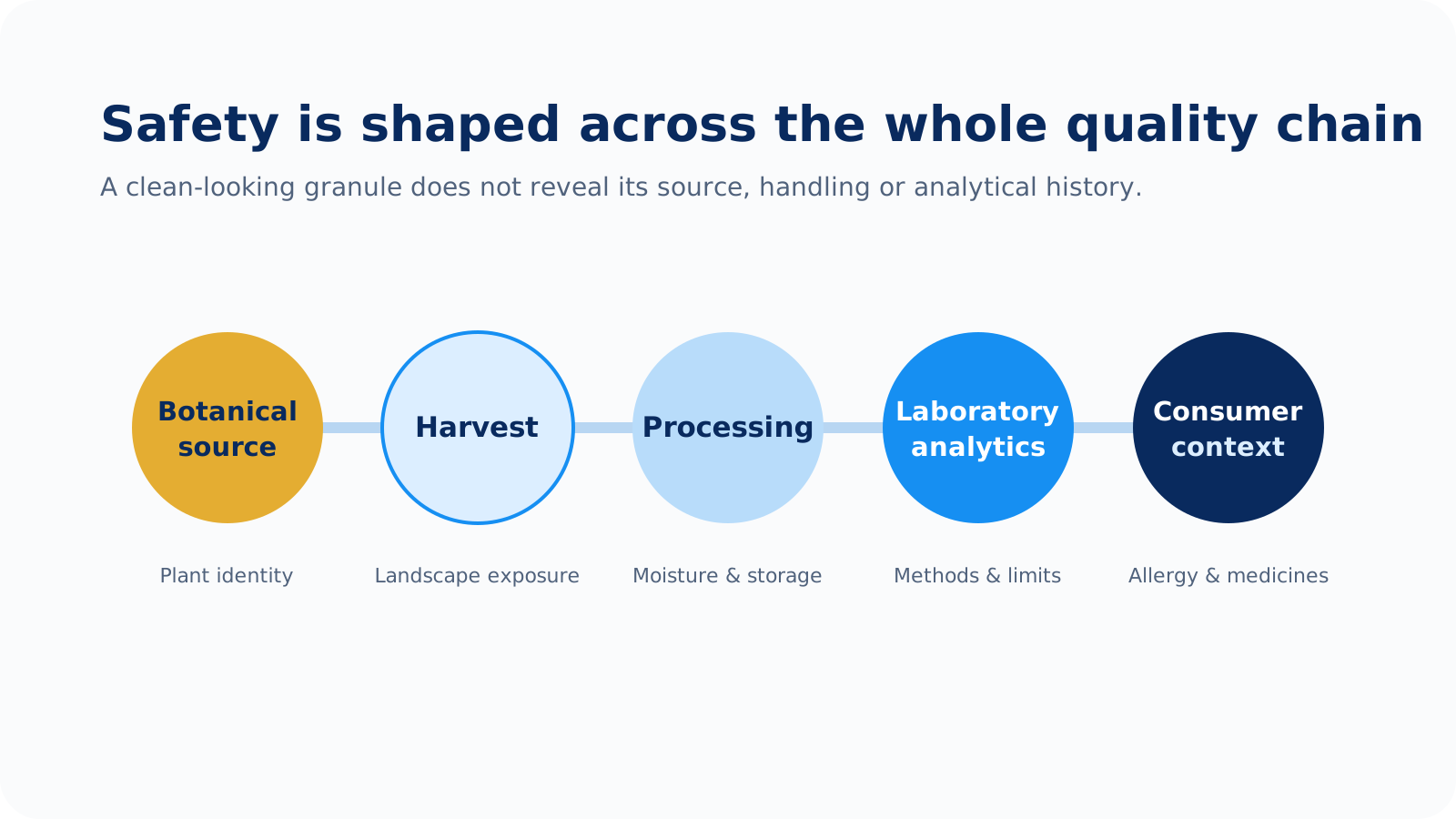
A high-quality bee-pollen product is shaped by an entire chain:
Botanical source Which plants contributed pollen?
Harvest environment What agricultural or environmental exposures were present?
Collection and storage Was moisture controlled?
Processing Was the product dried, frozen, milled, fermented or extracted?
Laboratory testing Were microbiology, pesticides, metals, plant toxins and mycotoxins assessed?
Traceability Can the results actually be linked to the specific batch being sold?
A certificate of analysis can be useful.
But its value depends on:
- what was tested,
- which methods were used,
- laboratory quality,
- detection limits,
- and whether the certificate truly belongs to that lot.
- What the research actually shows
What We Know
Serious allergic reactions to bee pollen have been documented in humans.
Commercial and field samples can contain pesticides, pyrrolizidine alkaloids, trace elements, fungi and mycotoxins.
The composition and safety profile of bee pollen vary by origin and handling.
What Looks Promising
Modern non-target analytical methods, traceability systems and broader batch testing could substantially improve transparency.
Standardised pollen-derived ingredients may also allow tighter quality control than heterogeneous raw products.
What We Still Don’t Know
We do not know:
- the global prevalence of clinically significant contamination,
- the incidence of severe reactions among all bee-pollen consumers,
- the full interaction profile,
- or how consistently retail products meet high-quality testing standards.
- Who should think more carefully about uncertainty?
The Premium Report identifies several contexts where uncertainty matters more:
- known pollen allergy,
- severe asthma,
- pregnancy,
- anticoagulation,
- complex medication use.
This is not personalised medical advice.
It reflects a simple risk principle:
When individual vulnerability is greater, missing evidence matters more.
Natural products still require evidence
Bee pollen’s natural origin is part of its appeal.
It is also the reason product identity can be difficult to control.
Plant species change.
Landscapes change.
Harvests change.
Storage changes.
That makes the most useful consumer question very different from:
“Is bee pollen natural?”
A better question is:
“Do I know what is actually in this batch, how it was handled, and whether its safety has been tested?”
The Science Hero Premium Report maps the full safety and quality landscape — allergy, interactions, pesticides, plant toxins, metals, fungi, mycotoxins, companies, modern screening methods and source-level evidence.
Research Summary
Is bee pollen safe?
Many people consume bee pollen without reported serious events, but documented human anaphylaxis and product-quality uncertainties mean it cannot be considered risk-free.
Can bee pollen cause anaphylaxis?
Yes. Published human case reports document systemic allergic reactions, including anaphylaxis.
Can bee pollen contain pesticides?
Yes. Analytical studies have detected pesticide residues in field and commercial pollen samples. Detection alone does not establish unacceptable risk.
Can bee pollen contain natural plant toxins?
Yes. Pyrrolizidine alkaloids produced naturally by some plants have been identified in pollen products.
Why does batch testing matter?
Botanical origin, environment, processing and storage can change both nutrient composition and contaminant profile.
Is every bee-pollen product equivalent?
No. Composition, botanical origin, processing and quality control can differ substantially.
Original scientific sources
- Choi et al. 2015 — Bee pollen-induced anaphylaxis
- Hurren & Lewis 2010 — Probable interaction between warfarin and bee pollen
- Kempf et al. 2010 — Pyrrolizidine alkaloids in pollen products
- Trombete et al. 2023 — Mycotoxins in international bee-pollen products
- Heeren, Kramer & Righetti 2026 — Suspect and nontargeted screening