
Female Health · Science Hero Editorial
Menstrual Blood Stem Cells: What Scientists Have Actually Found
Menstrual blood stem cells are drawing scientific interest, but what does the evidence actually show? A clear guide to MenSC research and its limits.
The phrase “menstrual blood stem cells” sounds dramatic.
It can easily trigger two bad reactions at once. Some people dismiss it as fringe science. Others jump too quickly to the opposite extreme and assume it must be the next big breakthrough in regenerative medicine.
The current evidence supports neither reaction.
What it supports is something more precise: researchers have identified a stem-like stromal cell population in menstrual blood, and that discovery opened a serious field of research. But the gap between a researchable cell population and a proven human therapy is still large.
So the central question is simple: what are menstrual blood stem cells, and what does the research actually show?
Why this matters
Regenerative medicine is full of bold ideas. But not all cell sources are equally accessible, and not all are easy to study or collect.
Menstrual blood attracted attention because it offered something unusual: a non-invasive, recurring source of cells that showed strong growth potential under laboratory conditions. That made researchers ask whether these cells might become useful for tissue repair, inflammation control, or disease-related research.
The answer, so far, is scientifically interesting — but still incomplete.
Where the field began
The modern field usually starts with the landmark 2007 paper by Meng and colleagues, who described what they called endometrial regenerative cells from menstrual blood.
Their study reported several features that made the field take notice:
- the cells were adherent in culture
- they could be expanded through many population doublings
- they showed a marker profile associated with mesenchymal stromal cells
- they displayed multilineage differentiation under experimental conditions
- the authors reported a striking doubling time of about 19.4 hours under their lab conditions
That last number still gets repeated often. It is worth knowing — and also worth handling carefully.
A doubling time measured in one system is not a permanent biological law. Culture conditions, donor factors, passage number and lab methods all matter. So the 19.4-hour figure is part of the origin story, not proof that menstrual blood stem cells are universally superior to other stromal-cell sources.
What MenSCs actually are
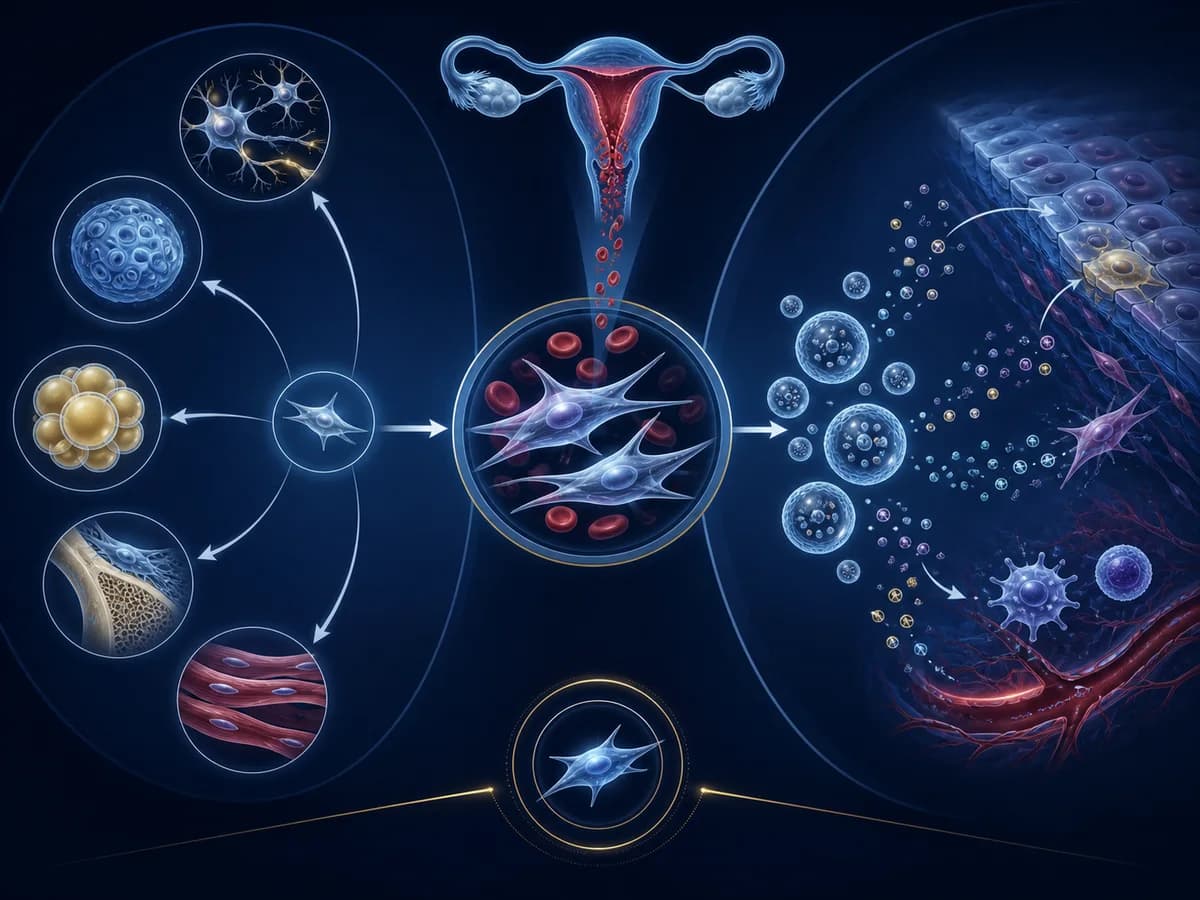
Today, these cells are usually discussed as menstrual blood-derived stem/stromal cells, often shortened to MenSCs.
They are usually placed within the broader family of mesenchymal stromal cells. That means researchers study them less as embryonic-style “master stem cells” and more as a stromal cell population with interesting proliferative, immunological and signaling behavior.
This distinction matters.
MenSCs are not exciting because they solve every problem in regenerative medicine. They are exciting because they are accessible, expandable, and biologically active.
A useful review in iScience from Sanchez-Mata and colleagues emphasizes that the field still faces issues of heterogeneity, terminology and standardization. Different labs do not always isolate, characterize or compare these cells in exactly the same way.
So yes, MenSCs are real. But the field is not fully standardized yet.
Why scientists became interested
At first, much of the focus was on differentiation: could these cells become multiple lineages in experimental settings?
That question still matters, but the field has shifted. Researchers increasingly focus on something else: what do MenSCs release, and how do those signals change tissue environments?
That includes cytokines, growth factors, extracellular vesicles, microRNA cargo and other paracrine signals.
In plain English: many scientists are less interested in the idea that the cells themselves become replacement tissue, and more interested in whether the cells help the body repair or regulate tissue through the signals they release.
This is a major conceptual upgrade in the field.
What areas are being studied?
MenSC research now touches several areas:
- wound healing
- endometrial repair and intrauterine adhesions
- ovarian function and fertility-related questions
- liver fibrosis
- neurological and spinal-cord injury models
- cartilage and extracellular vesicle research
- inflammatory regulation
That sounds broad, and it is. But breadth should not be confused with maturity.
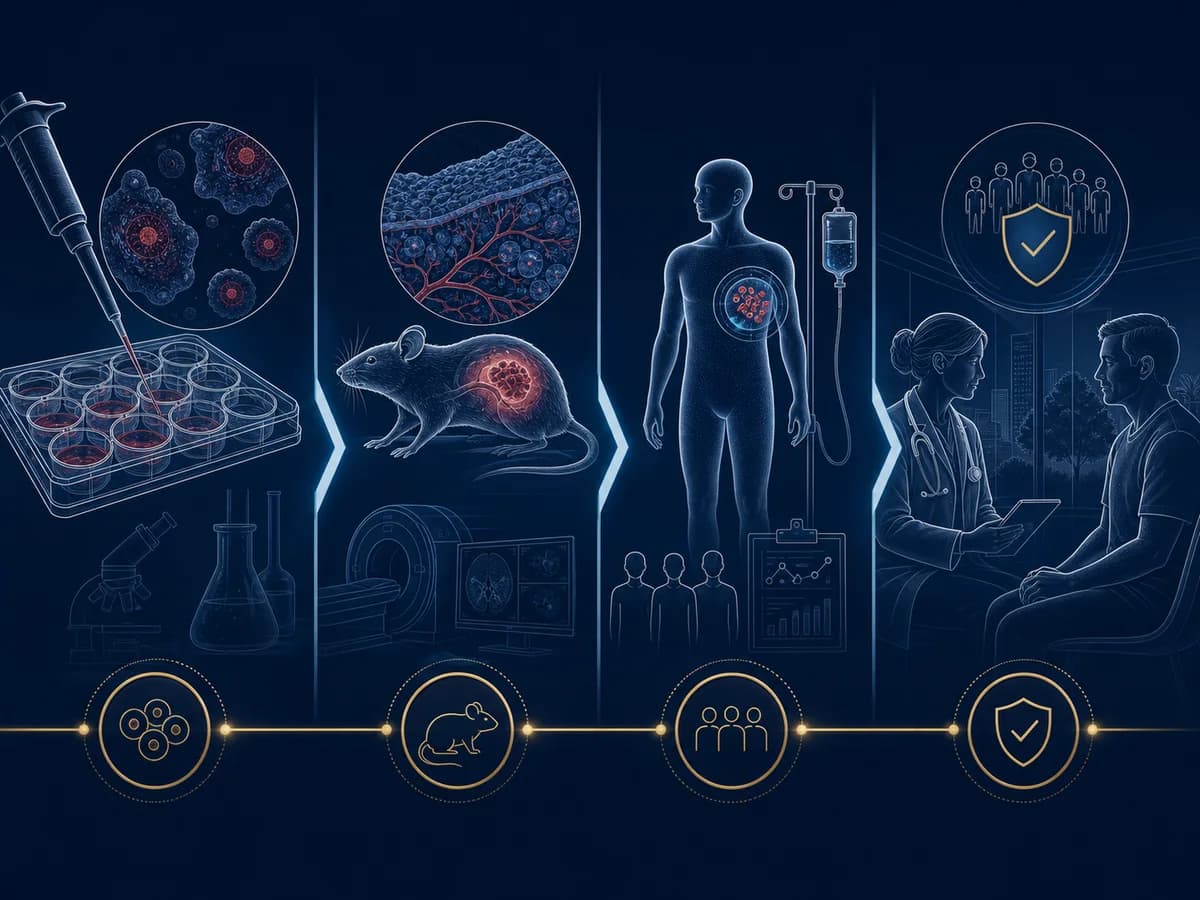
In many of these areas, the evidence is still preclinical. That means cells, cell products, mice, or other laboratory models.
Preclinical evidence can establish plausibility. It does not establish clinical benefit in humans.
What the research actually shows
What We Know
Researchers can isolate and expand MenSC-like stromal cell populations from menstrual blood.
The field is well established at the level of laboratory biology. MenSCs have been characterized in multiple studies, and their proliferative and signaling behavior has made them a serious topic in regenerative research.
What Looks Promising
The most promising work often involves paracrine effects — the idea that MenSCs may influence healing and inflammation by changing the surrounding biological environment.
This is one reason wound-healing and tissue-repair studies have drawn attention. For example, Evans et al. in The FASEB Journal showed that factors in menstrual fluid could support repair-related activity in laboratory and animal models. That does not prove a clinical therapy. But it strengthens the biological rationale.
Early human signals also exist in areas such as endometrial repair and ovarian function. Small studies and broader mesenchymal-stromal-cell reviews suggest possible promise, especially in difficult reproductive contexts.
What We Still Don’t Know
We still do not know whether MenSC-based therapies will produce strong, reproducible clinical benefit in large controlled human studies.
We also do not know which product format will prove most useful: whole cells, secretome-based approaches, extracellular vesicles, or something more refined.
And the field still needs stronger standardization in sourcing, manufacturing, potency testing and trial design.
One study or example worth knowing
The single most important study to know is still the 2007 Meng et al. paper.
Not because it proved a therapy.
But because it established the field.
It showed that menstrual blood could yield an expandable stromal cell population worthy of serious research attention. In science, that kind of origin paper matters because it changes what people believe is possible to study.
The limitation is equally important: origin papers open a field, but they rarely settle it. Everything that came after — reviews, comparative work, mechanistic studies and early human signals — is part of the real story.
Where human evidence begins
This is where careful language matters most.
There are early human signals in reproductive medicine, including work in severe intrauterine adhesions and poor ovarian response. A 2026 systematic review and meta-analysis in this broader field reported improvements in endometrial thickness and reproductive outcomes across mixed mesenchymal stromal-cell sources. But that is not the same as proof for MenSCs specifically.
Likewise, a 2025 long-term follow-up in poor ovarian responders reported encouraging outcomes after intra-ovarian autologous MenSC injection, but the study design limits how strongly the results can be interpreted. Signals are not yet the same as confirmed efficacy.
That is exactly why this field is exciting and unfinished at the same time.
The balanced conclusion
So what should an intelligent reader take away?
Menstrual blood stem cells are not a fantasy. They are a real research field with a credible scientific history.
At the same time, they are not an established regenerative therapy.
The strongest interpretation today is that MenSCs are a serious experimental cell population with promising biological behavior, especially around signaling, repair and immune-related effects. But the field still needs better standardization, larger human studies and clearer proof of clinical value.
That may sound less dramatic than the hype.
It is also more useful.
Research Summary
What are menstrual blood stem cells?
They are stem-like stromal cell populations isolated from menstrual blood and usually discussed under the label MenSCs.
When were they first described?
The foundational modern paper was published in 2007 by Meng and colleagues.
Why are scientists interested in them?
Because they are non-invasively accessible, can be expanded in culture, and may influence repair and inflammation through signaling effects.
Are menstrual blood stem cells a proven therapy?
No. They are a serious research field, but most proposed applications remain preclinical or early-stage.
What area looks most promising?
Paracrine signaling, tissue repair biology, and some reproductive applications appear especially important.
What remains unknown?
Large controlled human efficacy, product standardization, manufacturing consistency and long-term clinical value.